

The purpose of the Nuru Household (HH) survey is to collect data to evaluate the effectiveness of the interventions conducted by Nuru International’s programs. The survey primarily addresses Nuru’s Healthcare and Water & Sanitation programs. Due to the holistic nature of Nuru’s model, the survey also aims to assess a few outcomes that result from the overlap of the Agriculture, Community Economic Development (CED) and Education programs (Figure 1).
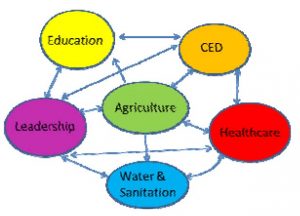 Nuru monitors and evaluates each program area – Agriculture, CED, Education, Healthcare, Leadership and Water & Sanitation. The monitoring system collects data about operational activities, such as the number of staff members visiting households or the number of health behaviors taught. The evaluation system collects outcome data that results from each activity. Outcomes include changes in behavior and attitude, such as the number of people reporting to have slept under bed nets or those with an improved ventilated pit latrine. Baseline data that is collected, like in the current survey, will not yet assess change in behavior or attitude, but rather the current situation of the community before programs are implemented.
Healthcare
From 2008-2010, the Nuru Healthcare program trained Representatives who were members of Nuru farmer groups. The Representatives were the first cadre of health trainers that the program attempted to train to disseminate disease prevention information. From the Representatives and from other individuals in the community, approximately 44 Community Health Workers (CHWs) were trained and supervised by Nuru Field Officers (FOs) and Field Managers (FMs). From 2010-2011, the Nuru Healthcare program worked with CHWs, who taught key health behaviors household-to-household in the sublocations of Nyametaburo and Nyangiti in Kuria West district. Nuru assisted in organizing and conducting trainings for the CHWs – providing skills training, supervision, and performance assessment for the home visit tasks. The Healthcare team will scale to the Ihore sublocation in May 2012, and Moheto and Ngochoni sublocations all in Kuria West district in June 2012. The HH Survey is currently being performed in the new sublocations to collect baseline data before the HC program initiates interventions.
The goal of the Nuru Healthcare program is to reduce the mortality rate of children under 5 years old in a sustainable and scalable way. The Healthcare team aims to communicate clear and correct messaging about disease prevention, teaching 6 key health topics which include:
- Safe motherhood
- Diarrhea
- Immunization and Newborn Care
- Pneumonia
- Malaria
- Nutrition
The Healthcare team teaches 8 key health behaviors within the topics, including:
- Fully immunize children under 1
- Sleep under insecticide-treated mosquito nets – especially pregnant women and children under 5
- Drink clean water
- Wash hands with soap
- Breastfeed newborns immediately and exclusively for 6 months
- Provide adequate supplementary feeding and vitamin A supplements for children under five
- Attend four antenatal care visits/safe delivery
- Treat danger signs quickly
Thus, the HH survey will also help to gauge which stage of behavior change community members are in, if at all, based on Nuru’s Healthcare program intervention. The HH Survey asks questions to determine if individuals know how to prevent certain diseases, if they know what causes diseases, and if they are making the changes to prevent diseases from occurring in the first place.
Below are the outcome indicators or program metrics the HH Survey will measure for the Healthcare program:
- % of mothers of children aged 0-23 months who had four or more antenatal care visits when they were pregnant with the youngest child
- % of deliveries occurring in a health facility
- % of households using safe drinking water
- % of households practicing good handwashing behaviors
- % of children aged 0-59 months who had diarrhea any time in the two-week period prior to the survey
- % of children aged 0-59 months with diarrhea in the last two weeks that was treated with ORS & zinc
- % of children fully immunized
- % of children aged 0-59 months reported to have had a cough and fast and/or difficult breathing due a problem in the chest in the last two weeks
- % of children aged 0-59 months reported to have had a cough and fast and/or difficult breathing due to a problem in the chest in the last two weeks who were taken to an appropriate health provider
- % of children aged 0-59 months who slept under an insecticide-treated net the previous night
- % of children aged 0-59 months with a report of fever in the last two weeks
- % of children aged 0-59 months with a report of a fever in the last two weeks who sought medical attention
- % of infants less than 12 months of age who were put to the breast within one hour of delivery
- % of infants under 6 months old (ages 0-5 months) who were exclusively breastfed in the last 24 hours
- % of mothers appropriately feeding their children aged 6-59 months
- % of children aged 6-59 months who received a high dose of vitamin A in the last six months
- % of caretakers of children aged 0-59 months who knew health danger signs for seeking immediate care (pneumonia, diarrhea, malaria, pregnancy, neonatal, delivery)
- % of caretakers of children 0-59 months who knew causes of pneumonia, diarrhea, malaria, pregnancy/delivery complications
- % of caretakers of children 0-59 months who knew how to prevent pneumonia, diarrhea, malaria, pregnancy/delivery complications
*Indicator generation based on research from existing organizations/methodology, including USAID KPC Surveys, Measure DHS USAID, MICS, MEASURE Evaluation
Water & Sanitation
The goal of the Water & Sanitation program is to reduce water-born diarrheal diseases in rural communities. This is carried out through H20 training, which consists of how to use clean water (purifying), hand washing, and using latrines.
Below are the outcome indicators or program metrics the HH Survey will measure for the Water & Sanitation program:
- % of households reporting use of latrine in the past 24 hours
- % of households practicing good* handwashing behaviors (*soap + washing at critical times)
- % of open defecation
- % of latrine coverage
- % of handwashing station coverage
Overlap of Programs
Additional questions related to agriculture were added to triangulate community-wide data for yield compared to Nuru yield for maize. Through the Community Economic Development (CED program, Nuru members can possibly access loans for paying for a plough, a plough cow or school fees. The following indicators are included in the HH survey due to their ability to cross-cut programs, supporting Nuru’s holistic model. They are not yet program metrics, but will help us begin to better understand the interplay between programs.
Agriculture-related metrics
- % of land households have for agriculture (crops, grass, trees, etc.) among those surveyed
- % of land households have for maize among those surveyed
- Average number of 90 kg bags of maize harvested last long-rainy season of households surveyed
Agriculture + CED metrics
- % of households surveyed owning a plough
- % of households surveyed owning a plough cow
CED + Education metric
- % of households surveyed able to pay school fees
Education-related metric
- % of households surveyed with out-of-school children
Logistics
To implement the survey, the M&E staff trained 6 teams with 2 enumerators each (12 total enumerators) to carry out day-to-day survey operations. One M&E Field Manager (FM) supervised 2 teams each, for a total of 3 survey groups. Each survey group carried out the survey in separate villages. The survey took approximately 40-50 minutes to complete. Each team aimed to complete 5 surveys per day, or 30 per day combined. A team of 3 data entry staff was also trained to Check, Score and Code surveys similar to the MPAT.